

Why Understanding How Altitude Affects Your HVAC System Matters for Washoe Valley Homeowners
How altitude affects your HVAC system is one of the most overlooked factors in home comfort — especially here in Washoe Valley, NV, where elevations commonly exceed 4,500 feet above sea level.
Here's a quick summary of what altitude does to your heating and cooling:
- Gas furnaces lose roughly 4% of heating capacity for every 1,000 feet above sea level — that's a 20% or more drop at typical Northern Nevada elevations
- Air conditioners and heat pumps can lose 6–15% of cooling capacity due to thinner, less dense air that makes heat transfer harder
- Blower motors move significantly less air mass at elevation — at 6,000 feet, a fan that moves 90,000 lbs of air per hour at sea level moves only 72,000 lbs
- Gas combustion becomes less efficient because there is less oxygen available, raising the risk of incomplete burning and carbon monoxide production
- Standard equipment calibrated at sea level will underperform without altitude-specific adjustments, conversion kits, or proper sizing
The root cause of all of these issues is the same: the air at higher elevations is thinner and less dense. That single physical reality ripples through every part of your HVAC system — from how your furnace burns fuel, to how your air conditioner sheds heat, to how hard your blower motor has to work just to move air through your home.
Most HVAC equipment is designed and tested at or near sea level. That means the ratings on the label — the BTUs, the SEER efficiency scores, the airflow specs — don't automatically translate to the performance you'll actually get living in the Sierra region. Without the right adjustments, your system works harder, wears out faster, and may even create safety hazards.
I'm Andrew Morrell, owner of Mountain West Heating & Air Conditioning, and after more than a decade of hands-on residential HVAC work in Northern Nevada, I've seen how altitude affects your HVAC system in ways that catch homeowners completely off guard. In this guide, I'll walk you through exactly what's happening inside your equipment at elevation — and what you can do about it.
The Science of Thin Air: How Altitude Affects Your HVAC System
To understand how altitude impacts your heating and cooling, we have to look at the basic physics of our atmosphere. At sea level, the weight of the air above us exerts an atmospheric pressure of about 14.7 pounds per square inch (psi).
As you climb higher into the Sierra Nevada foothills — whether you are in Reno (approx. 4,500 feet), Washoe Valley (approx. 5,000 feet), or up in Incline Village (over 6,350 feet) — there is less atmosphere pressing down from above. For every 1,000 feet of elevation gain, atmospheric pressure drops by roughly 1 psi. By the time you reach 5,000 feet, the pressure drops to approximately 12.2 psi, representing a 17% reduction in air density.
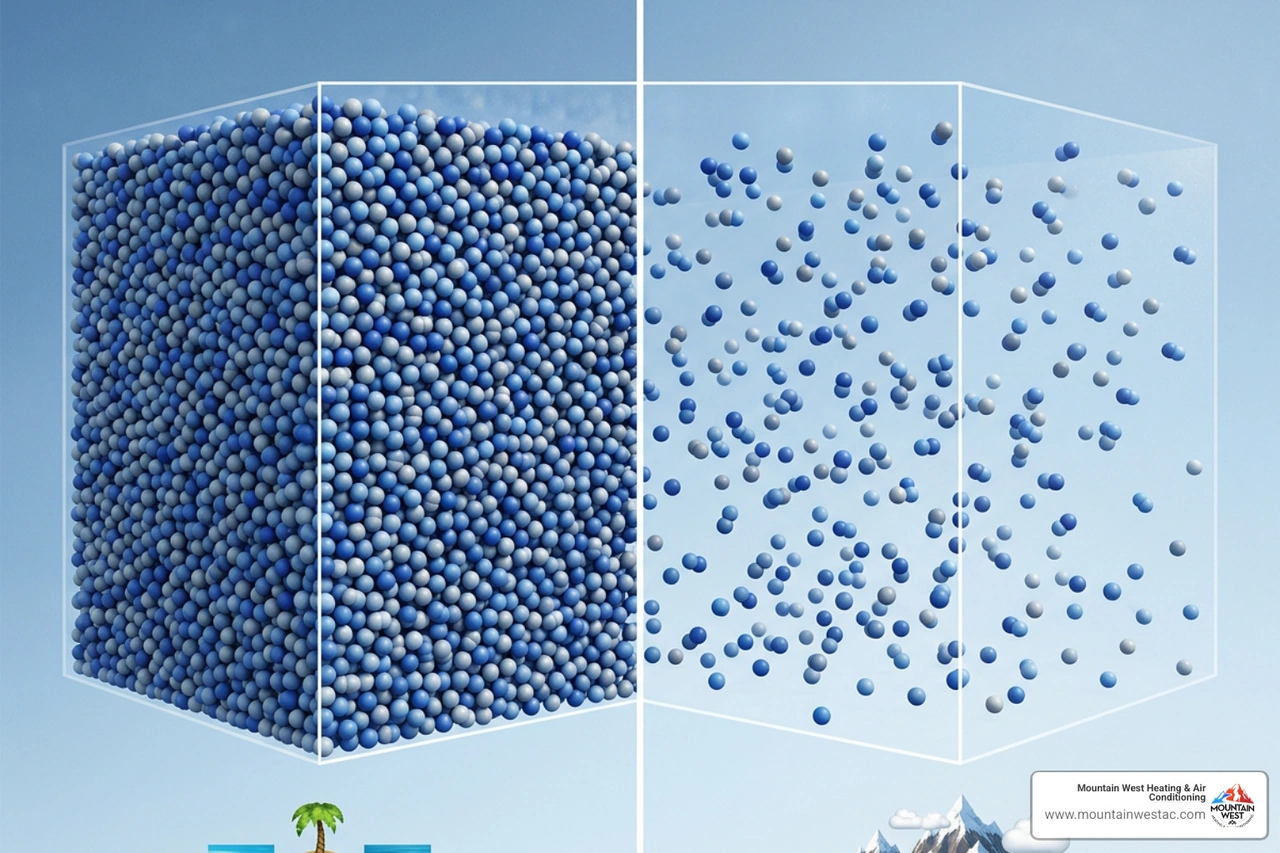
This drop in air density has two major consequences for your heating and cooling equipment:
- Reduced Mass Flow: Your HVAC system's blower fan is designed to move a specific volume of air (measured in Cubic Feet per Minute, or CFM). However, because the air is thinner, each cubic foot contains fewer air molecules. At 6,000 feet, the exact same fan moves only 72,000 pounds of air per hour compared to 90,000 pounds at sea level. This 20% reduction in air mass means your system has to run longer to deliver the same amount of heating or cooling energy to your living spaces.
- Impaired Heat Transfer: Air is the primary medium your system uses to transfer heat. In the summer, your air conditioner absorbs heat from inside your home and dumps it outside. In the winter, your furnace transfers heat from burning gas to the air circulating through your ductwork. Because thinner air has fewer molecules to carry thermal energy, heat transfer becomes significantly less efficient.
These physical limitations are why a standard, out-of-the-box system installed without proper calibration will struggle in our region. If you want to dive deeper into the core mechanics of this relationship, read our comprehensive breakdown on How Does Altitude Affect Your HVAC System.
Heating Challenges: Gas Furnaces and Heat Pumps at High Elevations
Northern Nevada winters are beautiful, but they can also be incredibly harsh. When the snow starts piling up in Carson City, Verdi, or Incline Village, you rely on your heating system to keep your family safe and warm. However, high-altitude heating presents unique engineering challenges for both gas-burning furnaces and electric heat pumps.
To maintain indoor comfort without sending your energy bills into the stratosphere, you have to account for these elevation-related efficiency losses. For practical advice on managing seasonal energy demands, check out our Summer Energy Efficiency Tips for the Sierra Region, which outlines key steps for optimizing your home's thermal envelope year-round.
Furnace Combustion and How Altitude Affects Your HVAC System
For a gas furnace to operate safely and efficiently, it requires a precise mixture of fuel (natural gas or propane) and oxygen. Since high-altitude air contains less oxygen per cubic foot, a standard furnace set to sea-level specifications will receive too much fuel and too little oxygen.
This imbalance leads to several serious issues:
- Incomplete Combustion: When there isn't enough oxygen to burn the fuel completely, the furnace produces a yellow, unstable flame instead of a crisp, blue one. This leads to heavy soot buildup on the burners and heat exchanger.
- Carbon Monoxide Risks: Incomplete combustion dramatically increases the production of carbon monoxide (CO), a colorless, odorless, and highly toxic gas. If your furnace's heat exchanger cracks due to thermal stress, this gas can leak directly into your home's air supply.
- The Need for Derating: To prevent incomplete combustion, gas furnaces installed above 2,000 feet must be "derated." Derating is the process of reducing the fuel input to match the reduced oxygen levels. This is typically done by installing smaller burner orifices (which restrict gas flow) and adjusting the gas valve manifold pressure. Standard industry practice is to derate a furnace by 4% for every 1,000 feet above sea level. This means a furnace in Washoe Valley at 5,000 feet will lose roughly 20% of its rated heating capacity.
Cold Climate Heat Pump Performance in Mountain Regions
Electric heat pumps are growing in popularity across Northern Nevada, but they are not immune to altitude effects. Unlike furnaces, heat pumps do not rely on combustion, so they don't face carbon monoxide risks from thin air. However, they do rely entirely on heat transfer across their outdoor and indoor coils.
Because high-altitude air is less dense, the outdoor fan moves less air mass across the outdoor coil. This reduces the heat pump's ability to extract heat from the freezing winter air. Additionally, the thin, dry mountain air affects how frost forms on the outdoor unit, sometimes leading to more frequent or prolonged defrost cycles. To compensate for this capacity loss, modern cold-climate heat pumps with variable-speed inverter compressors and larger coil surface areas are highly recommended for mountain regions like Somersett, Arrowcreek, and Montreux.
Cooling Challenges: Air Conditioning in Low-Density Air
While we talk a lot about winter heating, Northern Nevada summers bring intense, dry heat. In Reno, Sparks, and Dayton, daily summer temperature swings can exceed 30 to 40 degrees, with afternoon highs frequently climbing past 90°F or even 100°F.
Keeping your home cool in these conditions is already a challenge, but high altitude and arid desert air create a "perfect storm" for your air conditioner. To understand how our dry climate specifically impacts your cooling equipment, you can read more about How Dry Desert Air Affects HVAC Components.
Heat Dissipation and How Altitude Affects Your HVAC System
Your air conditioner's outdoor condenser unit has a critical job: it takes the heat absorbed from inside your home and releases it into the outdoor air. The condenser fan blows outdoor air across the hot condenser coils to facilitate this heat transfer.
At elevations between 4,500 and 7,000 feet, the thinner air has fewer molecules to absorb heat from those coils. As a result:
- Reduced Cooling Capacity: Air conditioners and heat pumps experience a 6% to 15% drop in overall cooling capacity at high elevations because the heat transfer process is less efficient.
- Increased Fan Motor Strain: Blower motors and condenser fans must work harder to move the same mass of air. This increased resistance and longer run times put extra mechanical strain on the fan motors, often leading to overheating and premature failure.
- Longer Run Times: Because the system cools less efficiently per cycle, it must run much longer to satisfy your thermostat settings, driving up your summer electricity bills.
Refrigerant Pressures and Compressor Strain
The physical properties of refrigerant are highly sensitive to atmospheric pressure. Because local atmospheric pressure is lower in high-altitude areas like Washoe Valley and Lakeview, the boiling and condensing points of the refrigerant inside your system shift.
This pressure drop can easily mislead technicians who are only trained to use standard sea-level pressure-temperature (PT) charts. If a technician charges your air conditioner using sea-level targets, they may overcharge or undercharge the system.
- Overcharging leads to liquid refrigerant flooding back into the compressor, which can instantly destroy it.
- Undercharging reduces cooling capacity even further and deprives the compressor of the cooling it needs to prevent overheating.
To protect your compressor, our technicians use specialized altitude-corrected PT charts and digital manifolds to precisely calculate superheat and subcooling targets for our specific elevation.
Sizing, Calibration, and High-Altitude Adjustments
Because altitude drastically alters how HVAC systems perform, you cannot simply buy a system based on its sea-level nameplate ratings. Sizing and installing equipment in Northern Nevada requires careful engineering calculations.
We use ACCA Manual J load calculations to determine exactly how much heating and cooling your home actually needs. Once we have those load requirements, we apply manufacturer-specific altitude derating factors to select the correct equipment size.
| HVAC Metric / Component | Sea-Level Performance | High-Altitude Performance (approx. 5,000 - 6,000 ft) | Necessary Adjustment / Solution |
|---|---|---|---|
| Atmospheric Pressure | 14.7 psi | ~12.2 psi (17% reduction) | None (physical law) |
| Air Mass Moved by Fan | 90,000 lbs/hour | 72,000 lbs/hour (20% reduction) | Upgrade to variable-speed blowers |
| Gas Furnace Heating Capacity | 100% of rated BTUs | ~80% of rated BTUs (20% loss) | Install high-altitude burner orifices & adjust gas pressure |
| AC / Heat Pump Cooling Capacity | 100% of rated SEER2 | 85% to 94% of rated capacity | Use altitude-corrected Manual J calculations |
| Combustion Safety | Clean, complete burn | High risk of incomplete burn & CO | Perform professional combustion analysis |
| Expected Equipment Lifespan | 15–20 years | 10–25% shorter if uncalibrated | Implement proactive, biannual maintenance |
One of the biggest mistakes a homeowner (or an inexperienced contractor) can make is oversizing the equipment to compensate for altitude capacity loss. If you install a massive furnace or AC unit without adjusting the ductwork, the system will "short-cycle" (turn on and off rapidly). This leads to uneven indoor temperatures, poor humidity control, extreme wear and tear, and early system failure.
Instead, the solution lies in proper calibration. This includes installing high-altitude conversion kits (which feature specialized pressure switches and smaller burner orifices) and utilizing variable-speed blower motors that can automatically ramp up their speed to maintain proper airflow mass despite the thinner air.
Essential Maintenance Practices for High-Elevation Systems
Operating an HVAC system at high altitude is a bit like driving your car up a steep mountain pass every single day — it simply has to work harder. Because of this constant extra strain, systems in regions like Caughlin Ranch, Northwest Reno, and VC Highlands require more proactive care. Without it, you could see a 10% to 25% reduction in your system's overall service lifespan.
To keep your system running safely and efficiently, we recommend focusing on three essential maintenance practices:
- More Frequent Filter Changes: Because thin air carries less heat, your system relies heavily on unrestricted airflow to prevent the furnace heat exchanger from overheating or the AC coils from freezing. Dirty air filters choke off this vital airflow. In our dry, dusty high-desert climate — especially during wildfire seasons — we recommend checking your filters monthly and replacing them at least every 60 days.
- Annual Combustion Analysis: For gas furnaces, a combustion analysis is the only reliable way to verify that your system is burning fuel safely at our elevation. Using specialized electronic analyzers, our technicians measure the exact levels of oxygen, carbon dioxide, and carbon monoxide in your furnace's exhaust gases to ensure the fuel-to-air ratio is perfectly balanced.
- Biannual Professional Tune-Ups: High-altitude systems should be professionally serviced twice a year — once in the spring for your cooling system, and once in the fall for your heating system.
To see what a truly thorough service looks like, review our detailed guide on What Does HVAC Maintenance Include Essential Services for System Longevity. If you want to prepare your cooling system for the summer heat, you can also follow our step-by-step AC Maintenance Checklist Essential Steps to Keep Your System Running Efficiently.
Frequently Asked Questions About High-Altitude HVAC
What elevation is considered high altitude for HVAC systems?
In the HVAC industry, 4,500 to 5,000 feet above sea level is generally recognized as the threshold where air density drops enough to significantly alter equipment performance. However, code requirements and manufacturer guidelines for gas combustion appliances often mandate derating adjustments starting at just 2,000 feet above sea level. Because almost all of our service areas — including Reno, Sparks, Carson City, and Washoe Valley — sit well above these thresholds, virtually every home in our region requires high-altitude considerations.
Do I need a special high-altitude kit for my furnace?
Yes, in most cases. If you are installing a standard gas or propane furnace at our local elevations, you will need a manufacturer-approved high-altitude conversion kit. These kits typically include smaller burner orifices to restrict gas flow (matching the reduced oxygen levels) and specialized, altitude-calibrated pressure switches. Standard pressure switches designed for sea level may fail to close properly in thinner air, preventing your furnace from starting up at all.
How often should I schedule HVAC maintenance in high-altitude areas?
Because high-altitude systems operate under higher physical strain and run longer cycles, we highly recommend scheduling professional maintenance twice a year — once before the winter heating season (September/October) and once before the summer cooling season (April/May). Regular maintenance not only keeps your system running at peak efficiency but also protects your manufacturer warranty, which can be voided if a system fails due to uncorrected altitude strain or neglect.
Conclusion
Living in Washoe Valley and the surrounding Sierra region means enjoying some of the most beautiful mountain landscapes in the country. However, it also means managing a unique high-altitude climate that demands specialized HVAC expertise.
At Mountain West Heating & Air Conditioning, we don't believe in "one-size-fits-all" sea-level solutions. We live and work right here in Washoe Valley, and we understand the exact physics of how our thin, dry mountain air affects your home's comfort systems. Whether you need a high-altitude furnace calibration in Arrowcreek, a custom AC installation in Carson City, or preventative maintenance in Incline Village, our experienced team is here to provide code-compliant, highly efficient solutions tailored to our unique climate.
Don't let the thin air wear down your system or drive up your energy bills. Contact our friendly, knowledgeable team today at Mountain West HVAC Services to schedule your high-altitude system assessment and ensure your home stays perfectly comfortable all year long.