

Why Altitude Has a Bigger Impact on Your HVAC System Than You Think
Understanding how does altitude affect your HVAC system is one of the most important things a Washoe Valley homeowner can know — because at elevation, your heating and cooling equipment is working against physics every single day. Here's a quick summary of what's happening:
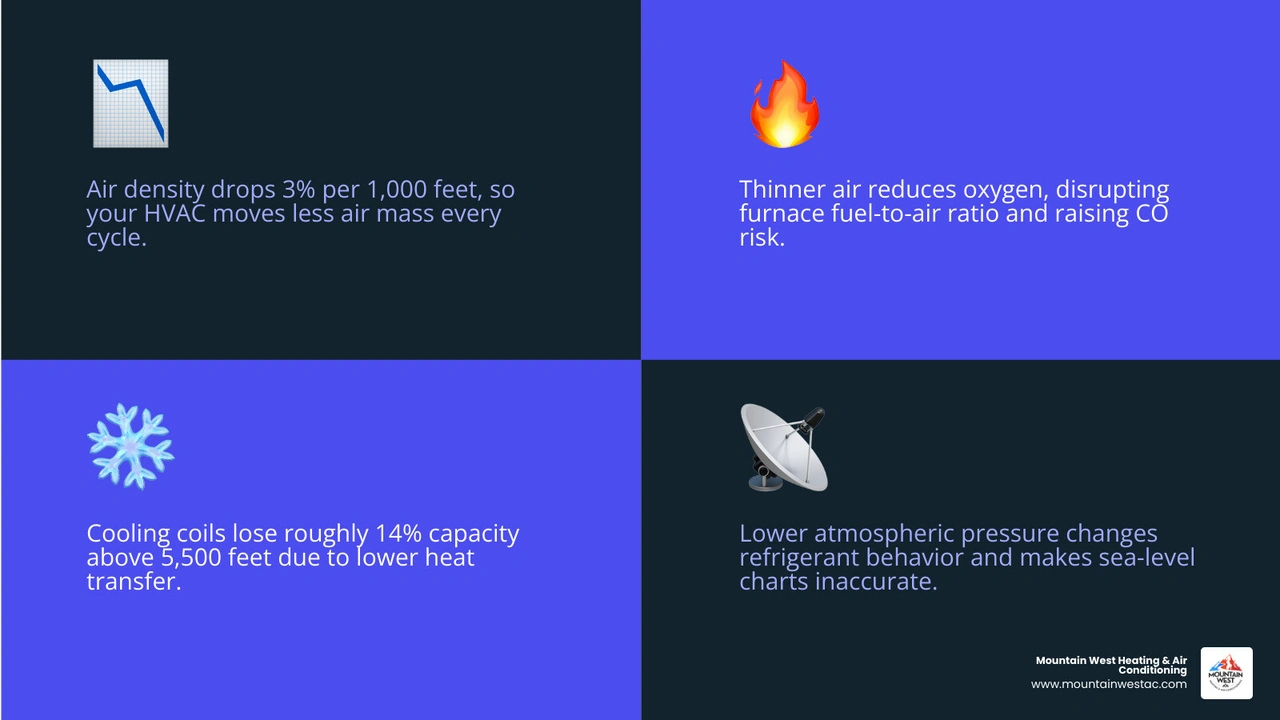
- Less air density: Air density drops about 3% for every 1,000 feet of elevation, meaning your system moves less air mass with every cycle
- Reduced combustion efficiency: Thinner air means less oxygen, which disrupts the fuel-to-air ratio in gas furnaces and increases carbon monoxide risk
- Lower cooling capacity: Cooling coils lose roughly 14% of their capacity above 5,500 feet due to reduced heat transfer
- Blower performance drops: A fan that moves 90,000 pounds of air per hour at sea level only moves about 72,000 pounds at 6,000 feet
- Refrigerant pressure changes: Lower atmospheric pressure shifts how refrigerant behaves, meaning sea-level charging charts give inaccurate readings
- Increased UV wear: UV radiation increases about 4% per 1,000 feet, accelerating wear on outdoor components
- Sizing challenges: Standard HVAC calculators can undersize systems for high-altitude homes by 15–25%
Washoe Valley sits at roughly 4,700 feet above sea level — close enough to the 5,000-foot performance threshold that altitude effects are very real for local homeowners. The combination of high elevation, low humidity, and dramatic temperature swings creates HVAC demands that standard sea-level systems simply aren't built to handle without proper adjustment.
I'm Andrew Morrell, owner of Mountain West Heating & Air Conditioning, and after more than a decade servicing homes in Northern Nevada, I've seen how altitude affects your HVAC system in ways that catch many homeowners completely off guard. In this guide, I'll walk you through exactly what's happening inside your equipment at elevation — and what you can do about it.
How Does Altitude Affect Your HVAC System in Washoe Valley?
Living in the shadow of the Sierras in places like Washoe Valley, Reno, or Incline Village offers breathtaking views, but it also presents a unique set of engineering hurdles for your home’s comfort systems. When we talk about how does altitude affect your HVAC system, we are really talking about two things: air pressure and air density.
At sea level, the weight of the atmosphere exerts about 14.7 pounds per square inch (PSI) of pressure on everything. By the time you reach the elevations found in Washoe Valley (approx. 4,700–5,000 feet), that pressure drops to roughly 12 PSI. This 18% reduction in pressure means the air is "thinner." There are fewer molecules of oxygen and nitrogen packed into every cubic foot of air your furnace or air conditioner tries to process.
Understanding the 5,000-Foot Performance Threshold
In the HVAC industry, 5,000 feet is the "magic number" where standard operations begin to falter. Most manufacturers design their equipment to work perfectly at sea level. Once you cross that 5,000-foot threshold, the drop in atmospheric pressure becomes so significant that the equipment can no longer meet its nameplate ratings.
For residents in higher-elevation areas like Arrowcreek, Montreux, or Galena, this is even more critical. If your system isn't specifically calibrated for these elevations, you aren't just losing efficiency; you are putting unnecessary strain on every mechanical component in the box.
| Property | Sea Level | 6,000 Feet (High Altitude) | Change |
|---|---|---|---|
| Air Pressure | 14.7 PSI | 11.8 PSI | -20% |
| Air Density | 0.075 lbs/cu ft | 0.060 lbs/cu ft | -20% |
| Oxygen Content | 100% (Baseline) | ~80% | -20% |
| Fan Mass Flow | 90,000 lbs/hr | 72,000 lbs/hr | -20% |
The Impact of Low Humidity and Temperature Swings
In Northern Nevada, altitude doesn't act alone. It’s compounded by our high desert climate. We frequently see 40-degree daily temperature fluctuations—where you might need the heater at 5:00 AM and the AC by 2:00 PM.
Furthermore, high-altitude air naturally holds less moisture. In the winter, indoor humidity levels in Washoe Valley can drop as low as 10-15% if left unmanaged. This dry air makes you feel colder than the actual temperature because moisture evaporates off your skin faster. It also forces your HVAC system to run longer to achieve a "perceived" level of comfort, leading to increased component stress and higher energy usage.
Why Thin Air Changes Furnace Combustion and Blower Performance
Your furnace is essentially a large, controlled fire. Like any fire, it needs three things: fuel (natural gas or propane), heat (the igniter), and oxygen. At 5,000 feet, there is roughly 20% less oxygen available in the air compared to sea level. This is the primary reason why how does altitude affect your HVAC system is a safety question as much as a comfort one.
How does altitude affect your HVAC system's combustion safety?
When a furnace designed for sea level is installed in a high-altitude home without adjustment, it ends up with a "fuel-rich" mixture. Because there isn't enough oxygen to burn all the gas, the combustion is incomplete. This leads to several dangerous and inefficient problems:
- Carbon Monoxide (CO) Risks: Incomplete combustion is a leading cause of elevated CO levels in the home.
- Soot Buildup: Unburned fuel creates carbon deposits (soot) that can clog your heat exchanger.
- Pressure Switch Failures: Thinner air exerts less force on the safety switches that tell your furnace it’s safe to fire up.
To fix this, we use "high-altitude kits." These kits typically include smaller burner orifices (the nozzles that spray the gas) to reduce the fuel flow to match the available oxygen. We also recalibrate the manifold gas pressure and adjust the pressure switches to ensure the system operates safely in thinner air. To keep these safety features in check, we highly recommend following an HVAC Maintenance: Essential Spring Checklist for Peak Performance.
Blower Motors and Airflow Resistance
While the furnace is burning fuel, the blower motor is responsible for moving that heat through your ducts. Here is the catch: a fan moves a specific volume of air (measured in cubic feet per minute, or CFM), but it’s the mass of the air that actually carries the heat.
Because the air is 20% less dense at 6,000 feet, your blower motor is moving 20% less weight. A fan that moves 90,000 pounds of air per hour at sea level only moves about 72,000 pounds here. This means the air spends more time in the heat exchanger, which can cause the unit to overheat and "limit out."
We often recommend variable-speed ECM motors for our clients in Somersett and Verdi. These smart motors can detect changes in static pressure and air density, adjusting their speed to ensure your home actually gets the thermal energy it needs to stay warm.
Cooling Capacity and Refrigerant Behavior in High-Elevation Climates
If you think the heater has it hard, the air conditioner faces its own set of challenges. When people ask how does altitude affect your HVAC system regarding cooling, the answer lies in heat transfer efficiency.
How does altitude affect your HVAC system's cooling capacity?
Your AC doesn't actually "create" cold; it removes heat from your home and dumps it outside. This process relies on air blowing across coils. Since the air is thinner at high altitudes, there are fewer air molecules to grab the heat from the indoor coil and fewer molecules to carry it away from the outdoor condenser.
As a result, cooling coils lose about 14% of their capacity once you get above 5,500 feet. This is why a 3-ton unit that works perfectly in a 2,000-square-foot home in San Francisco will struggle to cool the same size home in Reno or Carson City during a July heatwave.
Additionally, refrigerant behavior changes with atmospheric pressure. The boiling point of liquids (including refrigerant) drops as pressure decreases. Technicians who use standard sea-level charging charts will almost always get the refrigerant levels wrong. We use specialized pressure-temperature charts that account for Washoe Valley’s specific elevation to ensure we don't overstress the compressor. Regular check-ups are vital, so be sure to review our AC Maintenance Checklist: Essential Steps to Keep Your System Running Efficiently.
UV Radiation and Outdoor Component Wear
Up here, we are closer to the sun and have less atmosphere to filter out harsh rays. UV radiation increases by about 4% for every 1,000 feet of elevation. In the Virginia Foothills or VC Highlands, your outdoor unit is getting hammered by roughly 20-25% more intense UV light than a sea-level unit.
This intensity accelerates the degradation of:
- Capacitors: The "batteries" that start your motor can dry out and fail faster.
- Wire Insulation: Plastic and rubber coatings can become brittle and crack.
- Fan Blades: Composite materials can weaken over time.
- Coil Fin Corrosion: The intense solar load combined with wind-blown dust can physically degrade the delicate aluminum fins on your condenser.
How Should I Size a New HVAC System for a High-Altitude Home?
One of the biggest mistakes we see in Northern Nevada is the use of "rule of thumb" sizing. If a contractor tells you that you need "one ton of cooling for every 500 square feet" without doing a calculation, they are likely undersizing your system by 15-25%.
When we perform a Manual J load calculation—the industry standard for sizing—we have to apply altitude correction factors. For a home at 6,000 feet, we often have to increase the BTU requirements significantly just to compensate for the thin air. For a deeper dive into this process, check out our guide: What Size AC Unit Do I Need: A Guide to Finding the Perfect Cooling System for Your Home.
Selecting Altitude-Rated Equipment
Not all HVAC equipment is created equal. For high-altitude environments like Incline Village or Glenbrook, we look for specific features:
- Two-Stage or Modulating Furnaces: These systems can adjust their output to match the thinner air and fluctuating temperatures, preventing the "all or nothing" blast of heat that leads to inefficiency.
- Variable-Speed Blowers: As mentioned, these are essential for maintaining proper mass airflow.
- Cold-Climate Heat Pumps: Modern inverter-driven heat pumps are excellent for our region because they can maintain capacity even when the air is thin and cold.
- High AFUE Ratings: Since your system has to work harder, starting with a 96% or higher efficiency furnace helps offset the natural loss of performance caused by elevation.
The Role of Whole-Home Humidification
Because the air at high altitudes is naturally dry, a whole-home humidifier is often the "missing link" in a high-altitude HVAC system. By maintaining an indoor humidity level between 30% and 50%, you can actually keep your thermostat a few degrees lower and feel just as warm.
Humidification also protects your home's infrastructure—preventing wood floors from shrinking, reducing static electricity that can fry electronics, and keeping your family’s respiratory systems healthy during the dry Washoe Valley winters.
Frequently Asked Questions about High-Altitude HVAC
What is considered high altitude for HVAC systems?
In the HVAC world, anything above 2,000 feet requires attention, but the most dramatic changes occur at 5,000 feet and above. If you live in Washoe County, you are almost certainly in a high-altitude zone.
Do I really need a high-altitude kit for my furnace?
Yes. Without it, your furnace will burn too much fuel for the amount of oxygen available. This leads to "sooting," which ruins the heat exchanger, and increases the risk of carbon monoxide poisoning. It also voids most manufacturer warranties.
Why does my AC run longer in Washoe Valley than at sea level?
Because the air is thinner, it carries less heat. Your AC has to move more "puffs" of air to remove the same amount of heat as a system at sea level. This results in longer run cycles, which is why proper sizing and maintenance are so important.
Conclusion
At Mountain West Heating & Air Conditioning, we know that Washoe Valley isn't just another service area—it’s a unique environment that demands specialized knowledge. As of May 2026, the technology available to handle high-altitude challenges has never been better, but it still requires a professional touch to calibrate and maintain correctly.
Whether you are in Dayton, Lakeview, or Northwest Reno, your HVAC system is an investment in your family's comfort and safety. Don't let the thin air wear down your equipment or drive up your energy bills. From precision tuning to installing altitude-rated upgrades, we are here to ensure your home stays perfectly comfortable, no matter how high up you live.
If you want to ensure your system is ready for the next season, explore our Cooling Systems Maintenance services or give us a call today. We’ll help you take the "thin air" out of the equation.