

The Hidden New HVAC Benefits Beyond Comfort Most Homeowners Miss
The new HVAC benefits beyond comfort are real, measurable, and — for most homeowners — completely unexpected. Most people think of their heating and cooling system as a way to stay warm in winter and cool in summer. That's it. But today's high-efficiency systems do a lot more than manage temperature. They filter allergens, control humidity, protect your home's structure, reduce your utility bills, and can even boost your property value.
Here's a quick look at what modern HVAC systems actually deliver beyond basic comfort:
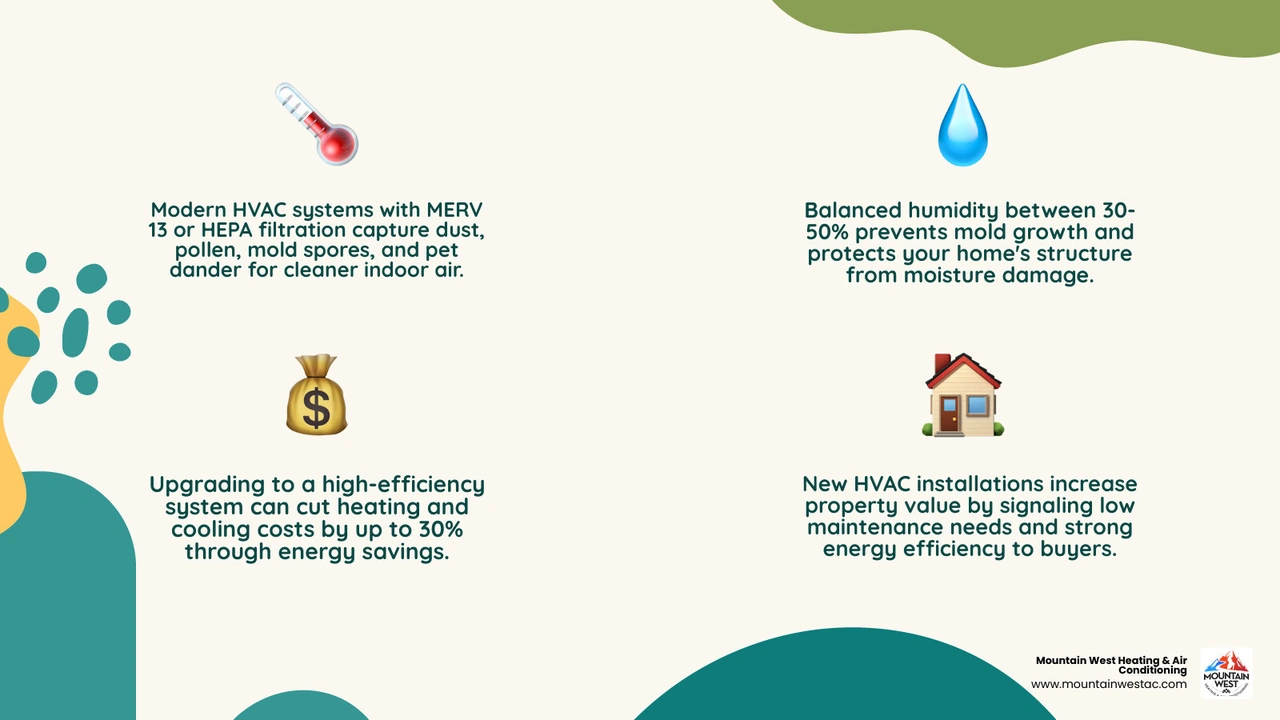
- Cleaner indoor air - MERV 13 and HEPA-grade filtration captures dust, pollen, mold spores, and pet dander
- Humidity control - Keeps indoor moisture between 30-50% to prevent mold growth and structural damage
- Lower energy bills - Upgrading to a high-efficiency system can cut heating and cooling costs by up to 30%
- Higher home value - A new system signals low maintenance and energy efficiency to potential buyers
- Quieter operation - Variable-speed technology runs at partial capacity with significantly less noise
- Built-in safety - Modern systems include carbon monoxide safeguards and real-time monitoring alerts
- Reduced environmental impact - Next-generation refrigerants like R-32 and R-454B carry a much lower global warming potential
If you live in a place like Washoe Valley, NV — where summer heat and winter cold push your system hard — these benefits aren't just nice to have. They're the difference between a home that works for you and one that quietly costs you more every month.
I'm Andrew Morrell, owner of Mountain West Heating & Air Conditioning, and after more than a decade working on residential systems throughout Northern Nevada, I've seen how the new HVAC benefits beyond comfort transform the way homeowners experience their homes. Keep reading for a practical breakdown of every benefit worth knowing about.
1. Health Wins: New HVAC Benefits Beyond Comfort

When we think about health investments, we usually think about gym memberships, organic groceries, or air purifiers that sit in the corner of a single room. But the single most impactful health investment in your home is actually humring away in your closet, attic, or backyard.
Your HVAC system is the "respiratory system" of your home. Because we spend up to 90% of our lives indoors, the quality of the air we breathe inside has a direct impact on our physical well-being. Older, outdated heating and cooling systems simply circulate the same stale air, dust, and microscopic debris from room to room. Modern systems, however, are engineered to actively clean, refresh, and balance your home's atmosphere.
To explore how these active improvements protect your family, take a look at our comprehensive guide on Indoor Air Quality Services: How to Improve the Air You Breathe at Home.
Advanced Filtration and the New HVAC Benefits Beyond Comfort
The filters in older systems were primarily designed to keep large clumps of dust from ruining the mechanical components of the unit itself. They weren't designed to protect human lungs.
Modern HVAC units are built to handle advanced filtration, specifically MERV 13 and HEPA-grade filters, without restricting airflow or placing undue strain on the fan motor.
- MERV 13 Filters: These are highly effective at capturing microscopic particles, including fine dust, pollen, mold spores, bacteria, and even virus-carrying droplets.
- HEPA Filtration: For homeowners with severe allergies or asthma, HEPA filters capture 99.97% of particles as small as 0.3 microns.
If your system is constantly recycling dust, you will notice it settling on your furniture and irritating your nasal passages. If you are constantly asking yourself, "Why does my home feel so stuffy?" it might be time to look at your ductwork and filtration. You can learn more about how dirty passages degrade your air by reading Is Your Air Feeling Dusty? Professional Duct Cleaning Services Can Improve Indoor Air Quality and HVAC Efficiency.
Humidity Control as One of the New HVAC Benefits Beyond Comfort
Here in Northern Nevada, our climate is notoriously dry. However, indoor humidity levels can fluctuate wildly depending on cooking, showering, and seasonal changes.
The sweet spot for indoor relative humidity is strictly between 30% and 50%.
- If humidity is too high (above 60%): You create a breeding ground for mold, mildew, and dust mites. High humidity also causes natural wood elements in your home — like hardwood floors, door frames, and structural beams — to swell and warp.
- If humidity is too low (below 30%): The air is incredibly dry, leading to itchy skin, dry sinus passages, nosebleeds, and static electricity. Dry air also causes wood to shrink, crack, and pull apart at the seams.
Modern HVAC systems excel at maintaining this delicate 30-50% balance. By regulating moisture levels, you prevent mold spores from taking root in your drywall and protect the structural integrity of your home's "bones."
2. Unmatched Energy Efficiency and Utility Savings in 2026
Heating and cooling account for nearly half of the energy usage in a typical U.S. home, making it by far the largest energy expense for most households. If you are operating an older system, you are likely overpaying for your monthly comfort.
With the technology available in 2026, upgrading to a high-efficiency system can reduce your heating and cooling bills by up to 30%. In our region, where we experience freezing alpine winters and scorching summer afternoons, those savings accumulate rapidly. For seasonal strategies to keep your system running optimally, check out our Summer Energy Efficiency Tips for the Sierra Region.
Variable-Speed Technology and SEER2 Standards
Older air conditioners operate like a single-stage light switch: they are either 100% on or 100% off. When your home warms up, the system kicks on at full blast, consumes a massive spike of electricity, cools the house down quickly, and shuts off. This constant cycling is incredibly inefficient and places heavy mechanical strain on the unit.
Modern systems utilize variable-speed technology (often called inverter technology). Think of it like cruise control for your home's climate. Instead of turning on and off constantly, a variable-speed motor runs continuously at a lower, incredibly efficient speed (often as low as 40% capacity). It dynamically adjusts its output to maintain a perfectly steady temperature, eliminating those costly energy spikes.
Additionally, today's systems are rated under the strict SEER2 (Seasonal Energy Efficiency Ratio 2) standards. While older systems in homes across Reno and Sparks might have SEER ratings as low as 10 or 12, modern 2026 systems offer ratings up to 20+ SEER2, using significantly less electricity to deliver the same amount of cooling. Discover more about how these efficiency standards save you money in The Benefits of AC You Need to Know Before Summer 2025.
Smart Thermostats and Zoning Systems
Pairing a new HVAC system with a smart thermostat allows you to leverage strategic temperature setbacks. Simply turning your thermostat back 7–10°F from its usual setting for about eight hours a day (such as when you are at work or asleep) can reduce your energy use by up to 10% annually.
To take efficiency a step further, modern systems can be configured with zoning systems. Instead of heating or cooling your entire house to a single temperature, zoning uses automatic dampers inside your ductwork to direct conditioned air only to the rooms you are currently using.
- Why waste energy conditioning a guest bedroom or a basement that no one is occupying?
- Implementing a zoning system can lead to energy savings of 21% to 42% while reducing overall system wear and tear.
To understand how this works in detail, read our article: What is a Zone Control System and Should Your Home Have One? Understanding HVAC Zones for Energy Efficiency and Comfort.
3. Structural Protection, Safety, and Whisper-Quiet Operation
When evaluating a new HVAC system, it helps to compare the tangible differences between older technology and modern 2026 systems:
| Feature | Older HVAC Systems (10+ Years Old) | Modern 2026 HVAC Systems |
|---|---|---|
| Typical Efficiency | 10–13 SEER / Lower AFUE | 18–25 SEER2 / High-Efficiency Heat Pumps |
| Compressor Motor | Single-stage (On/Off at 100%) | Variable-speed (Inverter technology) |
| Average Lifespan | 10–15 Years | 15–25 Years (with routine maintenance) |
| Noise Levels | Loud, disruptive start-up cycles | Whisper-quiet (as low as 42 dB) |
| Refrigerant Type | R-22 (phased out) or R-410A | Eco-friendly R-32 or R-454B |
| Ductwork Air Loss | Wastes 20-30% of conditioned air | Sealed, highly insulated systems |
Beyond direct utility savings, upgrading your home's infrastructure protects your physical property and enhances daily peace of mind. For instance, did you know that losing and gaining heat through windows accounts for 25% to 30% of residential heating and cooling costs? Unsealed air leaks force your system to work harder, which is why understanding the relationship between your home's envelope and your HVAC is critical. Read more in The Benefits of Sealing Air Leaks: How to Improve Energy Efficiency in Your Home.
Preventing Mold and Moisture Damage
When warm, humid air collides with cold surfaces inside your walls or attic, condensation forms. Over time, this hidden moisture leads to wood rot, damaged drywall, and mold growth.
Modern HVAC systems manage this risk through advanced condensation control and balanced airflow. However, your HVAC system cannot do it alone; it must work in tandem with proper home insulation to prevent thermal transfer. Learn how to optimize this balance by reading How Proper Insulation Can Save on Your Heating and Cooling Bill: A Cost-Effective Energy Solution.
Boosting Resale Value and Inspection Confidence
For homeowners in Carson City, Reno, or Dayton looking to sell their properties, a new HVAC system is a powerful selling point.
When buyers tour a home, the age of the major mechanical systems is one of their top concerns. A system that is 15 years old represents an impending, costly replacement. Conversely, a newly installed, high-efficiency system backed by a transferable manufacturer warranty provides immense buyer reassurance. It shows the home has been meticulously maintained, increases the home's overall marketability, and ensures you breeze through the home inspection process without costly repair demands.
Advanced Noise-Reduction and Smart Safety Features
If your current outdoor AC unit sounds like a jet engine taking off every time it starts up, you will love the whisper-quiet operation of modern systems. Engineering advancements, such as insulated compressor blankets, swept-wing fan blades, and variable-speed motors, allow 2026 systems to operate at sound levels as low as 42 decibels — equivalent to a quiet library.
Furthermore, safety technology has taken a massive leap forward. Modern gas furnaces and heat pumps feature:
- Automatic Shut-Off Mechanisms: Instantly shut down the system if a block in the vent or a cracked heat exchanger is detected, preventing dangerous carbon monoxide leaks.
- Fire-Resistant Materials: Built with superior, modern safety-grade materials.
- Real-Time Smart Alerts: Send notifications directly to your phone if a system anomaly or restricted airflow is detected, allowing you to address minor issues before they become major emergencies.
Frequently Asked Questions About Modern HVAC Upgrades
How do I know if my current HVAC system is ready for replacement?
While a professionally installed HVAC system can last between 15 and 25 years with routine maintenance, most residential units begin to show significant signs of decline between 10 and 15 years of age.
If you are experiencing frequent, costly repairs, rising utility bills despite regular maintenance, or if your home has stubborn hot and cold spots that never seem to resolve, your system is likely ready for replacement. Additionally, if your system still runs on phased-out refrigerants, finding replacement parts and servicing the unit will only become more expensive over time.
How often should I clean or seal my home's ductwork?
An average home loses about 20% to 30% of the air moving through the duct system due to leaks, holes, and poorly connected ducts. This means you are paying to heat or cool your crawl space or attic instead of your living room!
We recommend having your ductwork professionally inspected and sealed to stop this costly air loss. Additionally, scheduling a professional duct cleaning every 3 to 5 years is essential to remove accumulated dust, pet dander, and allergens from your home's "circulatory system." For a deep dive into this topic, explore Why Air Duct Cleaning is Essential for Maintaining Indoor Air Quality in 2025.
What are the environmental benefits of upgrading to a new system in 2026?
Starting in 2025 and moving into 2026, environmental regulations have phased out older refrigerants like R-410A due to their high Global Warming Potential (GWP).
Modern 2026 systems utilize next-generation, eco-friendly refrigerants such as R-32 or R-454B. These advanced refrigerants have up to 78% less global warming impact than their predecessors and allow the system to transfer heat more efficiently, drastically reducing your household's overall carbon footprint.
Conclusion
Upgrading your heating and cooling system is about so much more than just surviving the next heatwave or winter storm in Northern Nevada. The new HVAC benefits beyond comfort touch almost every aspect of your daily life — from the purity of the air your family breathes to the size of your monthly utility bills and the long-term value of your home.
At Mountain West Heating & Air Conditioning, we specialize in providing code-compliant, highly efficient HVAC solutions tailored strictly to the unique, demanding climate of Washoe Valley, Reno, Sparks, Carson City, Dayton, and the surrounding Sierra region. Our knowledgeable, experienced technicians are here to help you design a system that turns your home into a healthy, highly efficient sanctuary.
Ready to experience these hidden benefits for yourself? Contact us today to explore your options on our Mountain West HVAC Services page and take the first step toward a healthier, more efficient home.