

Whole Home Generator Maintenance Tips That Keep Your Power On When It Matters Most
If you're looking for whole home generator maintenance tips, here's a quick overview of what every homeowner should be doing:
- Check oil levels monthly and change oil every 100–200 hours or once a year
- Inspect the battery for corrosion and test voltage every 6 months; replace every 2–3 years
- Run exercise cycles for 15–30 minutes weekly or monthly to keep the engine lubricated
- Replace air filters and spark plugs at least once a year
- Clear debris and maintain 3 feet of clearance around the unit at all times
- Inspect fuel lines for leaks, deformities, or pressure issues
- Schedule a professional tune-up at least once a year — more often in harsh climates
More than 70% of generator failures come down to poor maintenance. That's not a small number. And here in Washoe Valley, where winter storms, high winds, and temperature swings can knock out grid power without much warning, a generator that doesn't start is worse than not having one at all. The whole point of a standby generator is that it works when everything else stops — but that kind of reliability doesn't happen by accident. It takes a consistent, simple maintenance routine that most homeowners can build into their schedule without much hassle.
That's exactly what this guide is about. We'll walk you through a clear 7-day plan that covers every key maintenance task — from the quick DIY checks you can knock out in minutes to the professional services that protect your warranty and your investment.
I'm Andrew Morrell, owner of Mountain West Heating & Air Conditioning, with over a decade of hands-on experience helping Washoe Valley homeowners keep their home comfort and backup power systems running reliably. When it comes to whole home generator maintenance tips, I've seen how a little consistent care is the difference between a generator that fires up instantly during a blackout and one that leaves a family in the cold.
Why Standby Units Require More Care Than Portable Generators
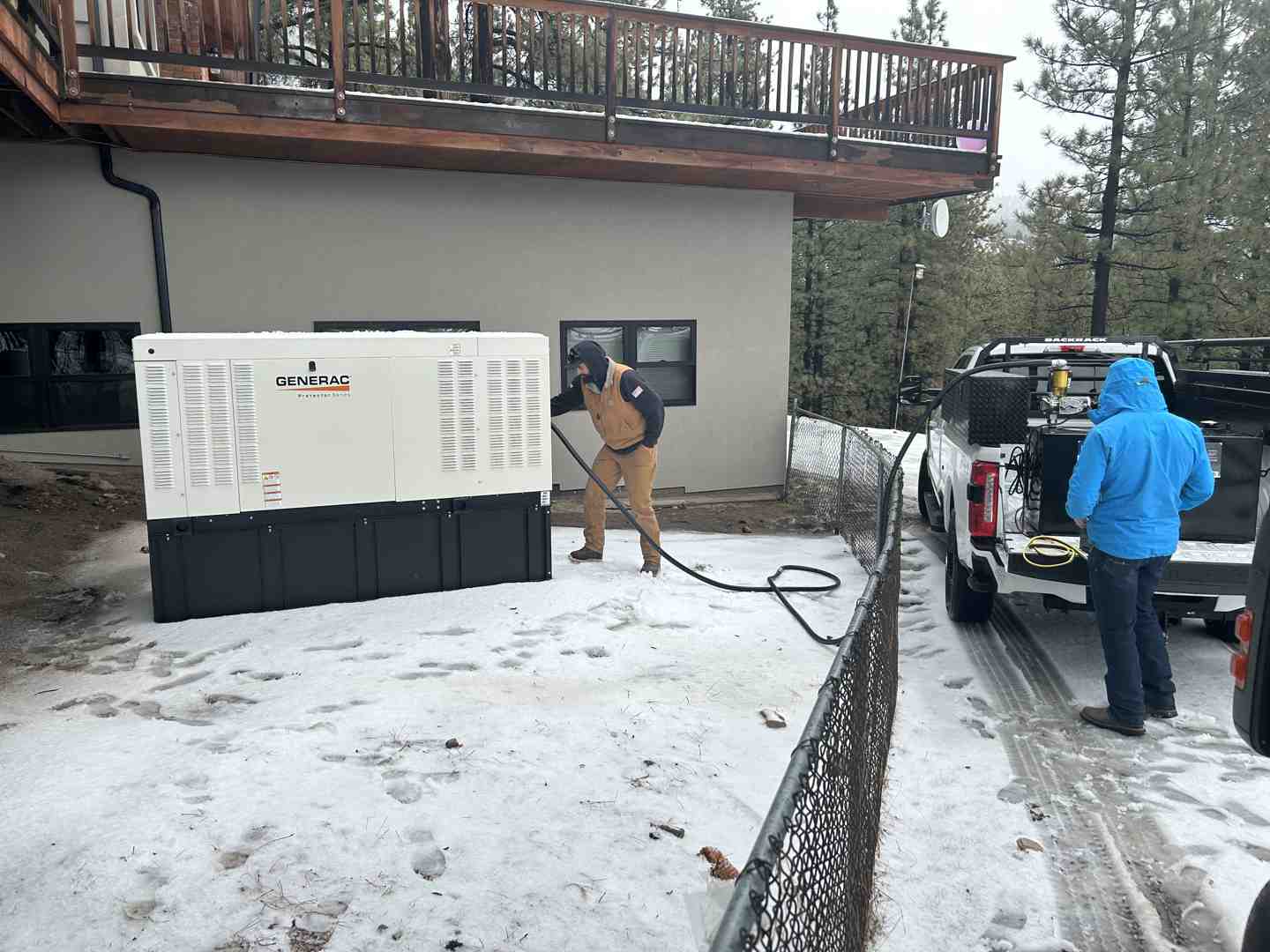
When preparing your home for power outages, it is vital to understand the operational differences between portable and permanently installed standby systems. While portable units are dragged out of the garage and manually started during an emergency, standby generators are integrated directly into your home's electrical system.
The heart of this automatic system is the Automatic Transfer Switch (ATS). When grid power fails, the ATS instantly senses the voltage drop, disconnects your home from the utility line, and signals the generator to start. This seamless transition is incredibly convenient, but it places a massive responsibility on the generator. A standby unit must sit ready for months in extreme outdoor conditions—ranging from freezing winter snow in Glenbrook to blistering summer heat in Reno—and then perform flawlessly under heavy electrical loads at a moment's notice.
Because standby generators start automatically and run without direct supervision, regular preventative care is critical. If a portable generator fails to start, you discover it while pulling the recoil cord. If a standby generator fails, you only find out when the lights stay off during a major storm, potentially risking frozen pipes, spoiled food, or the loss of critical medical equipment.
To understand why standby units require a more structured maintenance plan, consider how they compare to portable models:
| Maintenance Feature | Portable Generators | Whole-Home Standby Generators |
|---|---|---|
| Primary Fuel Source | Gasoline (stored in tanks, prone to spoiling) | Natural Gas or Liquid Propane (continuous supply) |
| Activation Method | Manual pull-start or electric push-button | Automatic Transfer Switch (under 10 seconds) |
| Typical Oil Change Interval | Every 50–100 hours of active use | Every 100–200 hours or at least once per year |
| Battery Requirements | Optional; often manual or small 12V starter | Heavy-duty 12V battery; must maintain constant charge |
| Self-Testing Capabilities | None; must be manually started by homeowner | Automated weekly or bi-weekly exercise cycles |
| Average Lifespan | 5–10 years (depending on usage and storage) | 20–30 years with proper preventative care |
For a deeper dive into which system fits your property best, check out our Whole Home Generator vs Portable Generator Comparison. Understanding these differences is the first step before you decide on What to Know Before Investing in Residential Generator Systems for your Northern Nevada property.
The 7-Day Plan: Essential Whole Home Generator Maintenance Tips
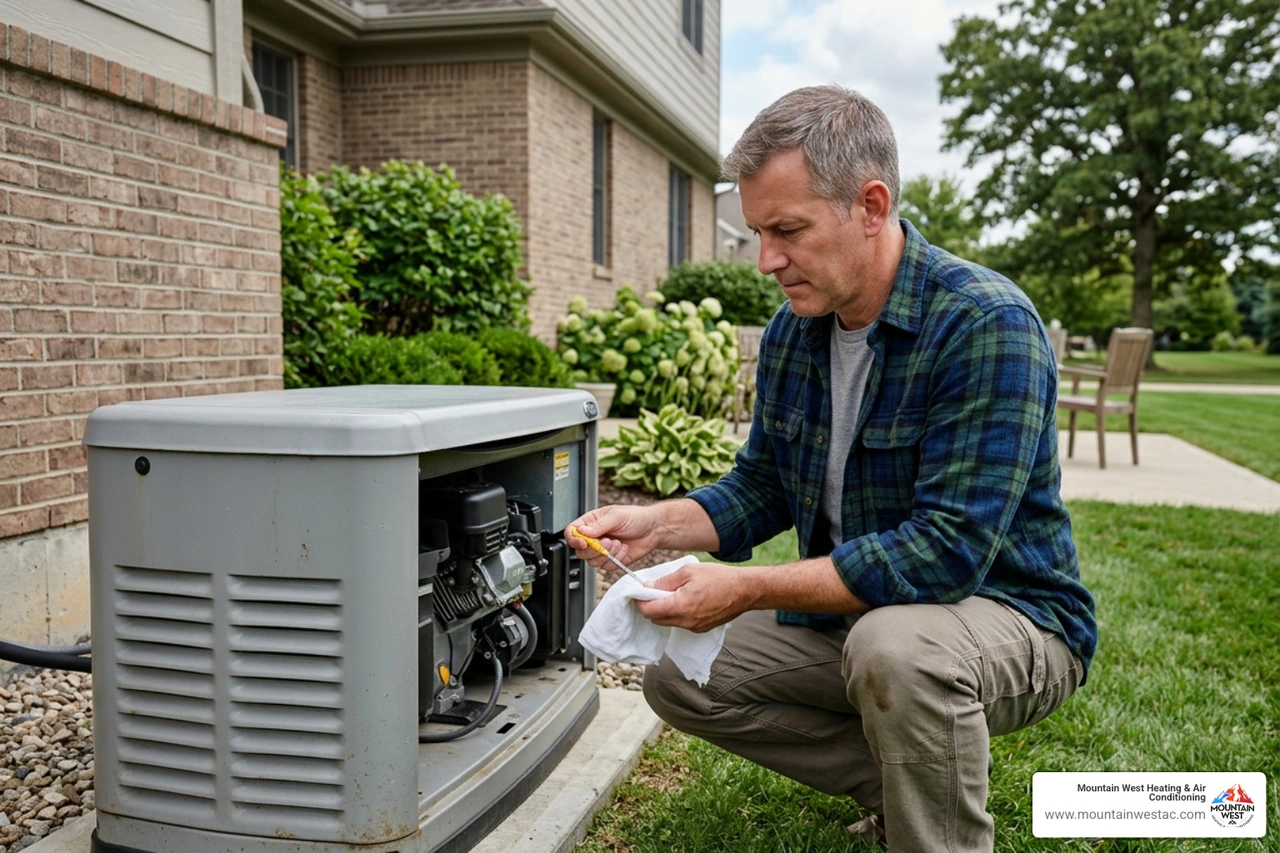
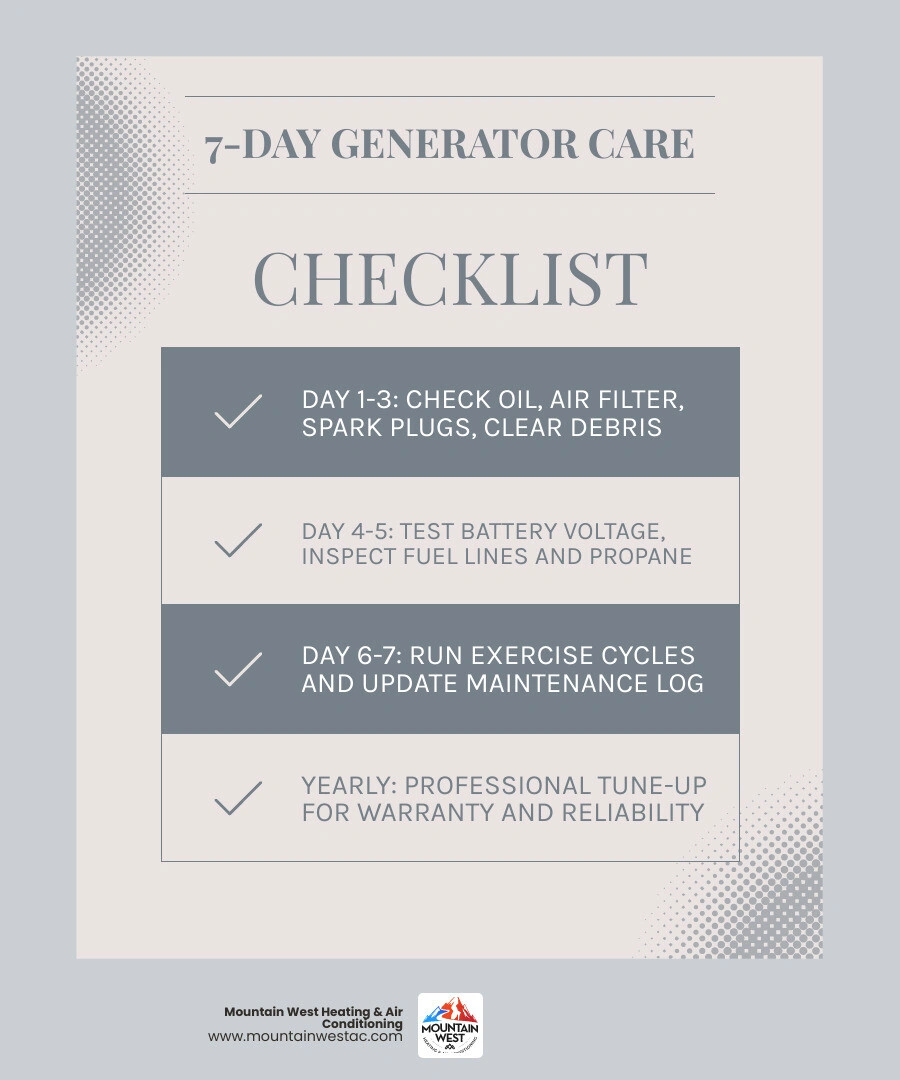
Taking care of a standby generator does not require hours of complex labor all at once. By breaking the work down into a simple, structured 7-day plan, you can easily verify every critical component of your backup power system. This systematic approach ensures your system remains in peak condition without overwhelming your weekly schedule.
Establishing a routine maintenance schedule is the single most effective way to protect your investment. To help you build this habit, we have outlined a straightforward plan that balances simple DIY visual checks with deeper component inspections. For a complete overview of keeping your backup power system healthy, read our comprehensive guide on Keeping Your Generator in Good Shape: Generator Maintenance Tips for Longevity.
Days 1-3: DIY Whole Home Generator Maintenance Tips for Homeowners
The first three days of our maintenance plan focus on the mechanical foundation of your generator's engine: oil, filtration, spark plugs, and physical cleanliness. These are tasks that most homeowners can safely perform with basic tools.
Day 1: Checking and Changing the Engine Oil
Just like your vehicle, your generator's engine relies on clean oil to lubricate moving parts, reduce friction, and dissipate heat.
- The Routine Check: Open the generator enclosure and locate the dipstick. Wipe it clean, insert it fully, and pull it back out to check the level. The oil should be clear, amber-colored, and sit firmly between the "Add" and "Full" marks.
- The Oil Change Interval: Most standby generators require an oil change every 100 to 200 operating hours, or at least once a year, whichever comes first. If you experience an extended utility outage where the generator runs continuously for days, you should check the oil level every 8 hours of runtime and shut the unit down to change the oil and filter after 100 hours of continuous operation.
- Pro Tip: In our cold Northern Nevada winters—especially in high-altitude areas like Incline Village and VC Highlands—using a high-quality full synthetic oil (such as 5W-20 or 5W-30) improves cold-weather starting and protects the engine from friction during freezing startups.
Day 2: Inspecting and Replacing Air Filters and Spark Plugs
An engine needs to breathe cleanly and ignite fuel efficiently to generate stable electricity.
- Air Filter Inspection: Open the air filter housing and pull out the paper element. Hold it up to a bright light. If light cannot easily pass through the pleats, or if you notice heavy dirt, oil spots, or physical damage, replace it immediately. A clogged air filter restricts airflow, causing the engine to run "rich" (too much fuel, not enough air), which leads to carbon buildup and reduced power output.
- Spark Plug Care: Remove the spark plug wire and use a spark plug socket to remove the plug. Inspect the tip. A healthy plug will have a light grey or tan deposit. If you see heavy black carbon soot, oil wetness, or a eroded electrode, it is time for a replacement. Spark plugs should be replaced every two years or every 200 operating hours to prevent engine misfires and hard starts.
Day 3: Clearing the Enclosure and Managing the Environment
Your generator's enclosure is designed to protect the internal components from the elements, but it requires proper airflow to prevent overheating.
- The 3-Foot Clearance Rule: Maintain at least 3 feet of clear space on all sides of the generator. Trim back fast-growing bushes, weeds, and overhanging branches.
- Debris and Pest Prevention: Clear away dead leaves, pine needles, and windblown trash from the intake and exhaust louvers. During cold weather, local rodents love to seek warmth inside generator enclosures, where they can chew through critical electrical wiring. Inspect the interior for nesting materials, and consider installing specialized base plugs or rodent guards to keep pests out.
For additional practical advice on these basic steps, explore our guide on Easy Generator Maintenance Services Tips Every Homeowner Should Know and learn how to perform a proper Generator Oil Change: Essential Maintenance Steps for Peak Performance.
Days 4-5: Battery Care and Fuel System Inspections
Days four and five shift the focus to the two systems responsible for getting the generator started and keeping it fueled: the electrical starter battery and the fuel delivery lines.
Day 4: Battery Integrity and Voltage Testing
Did you know that battery failure is the single most common reason home standby generators fail to start? The battery provides the initial surge of electrical power needed to crank the engine when the transfer switch detects a power loss.
- Visual Inspection: Open the battery compartment and check the terminals. Look for a white, powdery, or greenish-blue substance, which indicates corrosion. Clean the terminals using a stiff wire brush and a simple paste made of baking soda and water, then apply a corrosion inhibitor.
- Voltage Testing: Use a digital multimeter to check the battery's resting voltage. A healthy, fully charged 12V battery should read between 12.6 and 12.8 volts. If the reading drops below 12.4 volts, the battery may struggle to crank the engine, especially during a freezing winter night in Somersett or Verdi.
- Proactive Replacement: Even with perfect maintenance, generator batteries typically last only 2 to 3 years due to constant trickle charging and outdoor temperature fluctuations. Do not wait for the battery to die completely; replace it proactively to ensure emergency reliability. Learn more about this crucial task in our guide on Generator Battery Replacement: Essential Maintenance for Reliable Backup Power.
Day 5: Fuel System Inspections and Maintenance
Your generator's fuel system must be clean and leak-free to operate safely and efficiently. Standby units in Northern Nevada typically run on natural gas (NG) or liquid propane (LP).
- Natural Gas and Propane Connections: Visually inspect all flexible fuel lines leading to the generator for cracks, kinks, or signs of wear. Spray a mild soapy water solution over the connection joints while the system is pressurized; if you see bubbling, you have a gas leak that requires immediate professional repair.
- Propane Tank Levels: If your generator runs on liquid propane, monitor your tank levels closely. Never let your propane tank fall below 20% capacity, as low fuel pressure can cause the generator to stall or run poorly under load.
- Diesel Considerations: For homeowners with diesel-powered standby units, stale fuel is a major risk. Diesel fuel begins to degrade and accumulate moisture after several months, leading to algae growth and clogged fuel injectors. Always use high-quality fuel stabilizers and have your fuel polished or replaced regularly.
Days 6-7: Running Exercise Cycles and Keeping a Maintenance Log
The final two days of our maintenance plan are all about verifying operational readiness and establishing a record-keeping system to protect your manufacturer's warranty.
Day 6: Running Exercise Cycles and Preventing "Wet Stacking"
Modern standby generators are designed to run an automatic "exercise cycle" once a week or once every two weeks. This short run-time (typically 15 to 20 minutes) serves several vital purposes: it circulates engine oil to lubricate internal seals, charges the starter battery, and allows the system's controller to perform self-diagnostics.
- The Importance of Loaded Exercise: While idle self-tests are great, running your generator under a partial electrical load once a month is even better. Running an engine continuously with zero load can lead to a condition known as "wet stacking"—especially in diesel and larger gaseous units. Wet stacking occurs when unburned fuel, carbon, and moisture accumulate in the exhaust system because the engine never reaches its optimal operating temperature.
- What to Do: During your monthly exercise, manually trigger the generator to run under load by switching off your main utility breaker for 20 to 30 minutes. This forces the generator to power your household appliances, bringing the engine up to full operating temperature and cleanly burning off any internal fuel residue.
Day 7: Keeping a Detailed Maintenance Log
Consistency matters more than perfection when managing a backup power system. Keeping a written or digital maintenance log is the best way to track your generator's health over its 20-to-30-year life expectancy.
- What to Record: Every time you perform a visual check, change the oil, replace a filter, or have a technician service the unit, write down the date, engine run hours, tasks performed, and any parts replaced.
- Warranty Protection: If your generator experiences a major mechanical failure within its warranty period, the manufacturer will likely require proof of regular maintenance before covering repairs. Keeping a detailed log along with receipts for parts and professional services ensures you remain in full compliance with your warranty guidelines.
To learn more about setting up these essential habits, read our expert advice on how to Keep Your Generator in Good Shape: Generator Maintenance Tips for Longevity and explore how to Keep Your Generator Running Like New with These Routine Maintenance Musts.
Air-Cooled vs. Liquid-Cooled Generator Maintenance
When selecting or maintaining a whole-house standby system, you will encounter two primary engine designs: air-cooled and liquid-cooled. The maintenance requirements between these two systems differ significantly due to how they manage engine heat.
Air-Cooled Standby Generators
These are the most common units for standard residential properties, typically ranging from 8kW to 26kW in capacity.
- How They Work: Air-cooled engines use a high-velocity fan to blow outdoor air across the engine block to dissipate heat.
- Maintenance Focus: Because they rely entirely on external airflow, keeping the surrounding area clean is paramount. Any restriction in airflow—such as windblown leaves in Carson City or heavy winter snow accumulation in Washoe Valley—can cause the engine to overheat and shut down under load. Air filters must be checked frequently, and the external cabinet louvers must remain completely unobstructed.
Liquid-Cooled Standby Generators
These larger systems (typically 22kW to 150kW+) are designed for larger estate homes, properties with high electrical demands, or light commercial buildings.
- How They Work: Similar to an automobile, a liquid-cooled generator uses an internal radiator, water pump, and liquid coolant (antifreeze) flowing through the engine block to manage operating temperatures.
- Maintenance Focus: Liquid-cooled units require all the standard engine checks plus comprehensive cooling system maintenance. You must regularly check the coolant level in the overflow reservoir when the engine is cold. Hoses and belts must be inspected for cracks, soft spots, or dry rot. Additionally, the coolant should be flushed and replaced every 2 to 3 years to prevent internal corrosion and protect the engine from freezing during our harsh Northern Nevada winters.
For a localized look at managing these environmental demands, consult our detailed Washoe Valley Generators Maintenance Guide.
When to Call a Professional for Your Standby Generator
While basic visual checks, oil top-offs, and debris clearing are perfectly safe for homeowners to perform, certain advanced maintenance tasks require the expertise, specialized tools, and safety training of a professional technician. Working with high-voltage electrical circuits, pressurized natural gas lines, and complex engine diagnostics carries inherent safety risks.
We recommend scheduling a professional preventative maintenance service at least once a year—ideally in the spring before storm season, or in the autumn before heavy winter weather hits Northern Nevada.
A professional maintenance visit includes critical services that cannot be done on a DIY basis:
- Load Bank Testing: A technician connects a specialized machine to your generator to test its performance across its entire electrical capacity. This verifies that the generator can deliver stable power under maximum household demand without overheating or dropping voltage.
- Automatic Transfer Switch (ATS) Diagnostics: The ATS is a complex electrical component. Technicians inspect the internal contactors, test the voltage sensing relays, and verify that the switch transfers power safely without creating dangerous electrical arcs.
- Software and Firmware Updates: Modern standby generators use electronic control panels that require periodic software updates to optimize fuel efficiency, improve cold-weather starting algorithms, and resolve known system bugs.
For professional support in your specific area, you can easily connect with our local experts through our Generators Maintenance Guide Sparks NV or reach out directly to our Generators Maintenance Experts in Washoe Valley NV.
Professional Whole Home Generator Maintenance Tips and Warning Signs
Even between scheduled professional visits, you should monitor your generator for early warning signs of mechanical or electrical trouble. If you notice any of the following issues, shut the unit down (if safe to do so) and call for professional service immediately:
- Fluid Leaks: Any signs of wetness or pooling liquid beneath the generator enclosure—whether it is amber-colored engine oil, bright green or pink coolant, or a strong smell of fuel—indicate a failing gasket, hose, or line that must be addressed immediately.
- Diagnostic Warning Lights: Most modern generators have an external status light (often green for healthy, yellow for pending maintenance, and red for a system fault). If you see a yellow or red warning light, or if the control panel displays an active error code, do not reset it without fixing the underlying issue.
- Slow or Struggling Crank: If you hear the engine cranking slowly or struggling to start during its weekly exercise cycle, this is an early warning of a failing starter motor, a dying battery, or a fuel delivery restriction.
- Unusual Noise or Excessive Vibration: While generators are naturally loud, a sudden change in operational sound—such as metallic rattling, heavy knocking, squealing belts, or excessive cabinet vibration—signals loose internal components or failing bearings.
Frequently Asked Questions about Generator Maintenance
How often should a whole home generator be exercised?
A whole home generator should be run on an exercise cycle once a week or once every two weeks for 15 to 20 minutes. This regular run-time circulates engine oil to lubricate internal seals, prevents moisture buildup inside the engine, and keeps the starter battery charged.
What is the most common cause of generator failure?
A dead or weak 12V starter battery is the most common reason a home standby generator fails to start during a power outage. Generator batteries degrade over time due to constant charging and outdoor temperature swings, and they typically require replacement every 2 to 3 years.
Will DIY maintenance void my generator warranty?
No, performing basic DIY maintenance like checking oil levels, replacing air filters, and clearing debris will not void your manufacturer's warranty. However, you must keep a detailed maintenance log with dates, engine run hours, and receipts for all parts purchased to prove the unit has been cared for according to manufacturer guidelines.
Conclusion
A whole-home standby generator is one of the most significant investments you can make to protect your property and ensure your family's comfort during extreme weather. By committing to a simple, structured maintenance routine—and partnering with certified professionals for annual tune-ups—you can rest easy knowing your backup power system will perform flawlessly the moment the grid goes dark.
At Mountain West Heating & Air Conditioning, we are dedicated to helping our neighbors throughout Washoe Valley, Reno, Sparks, and the surrounding Northern Nevada communities maintain reliable home comfort systems. Our team of knowledgeable, experienced technicians provides prompt, professional, and code-compliant services tailored to our unique high-desert and mountain climate.
Don't wait for the next winter storm or high-wind alert to test your system's readiness. Schedule professional generator services with Mountain West Heating & Air Conditioning today, and let us help you keep the lights on, no matter what the weather brings.